
Criminal Cases in the Seward County Courts
Seward County Court hears misdemeanors, traffic violations, and municipal-ordinance cases. It also conducts the first hearings in felony matters. If a felony is bound over, the Fifth Judicial District Court becomes the principal trial court. District Court also hears appeals from County Court. The two files can relate to the same incident but have different case numbers, dates, and docket entries.
Clerk Magistrate Kimberly Haberman is listed for County Court. Sheila Lueders is the Clerk of District Court. Each clerk maintains the file for that court, accepts focused copy requests, and provides public-terminal access under Nebraska court policy. Seward, Milford, and Utica do not have separate municipal courts to search. Their ordinance matters route through Seward County Court.
The official County Court page identifies the local misdemeanor and preliminary-hearing court.
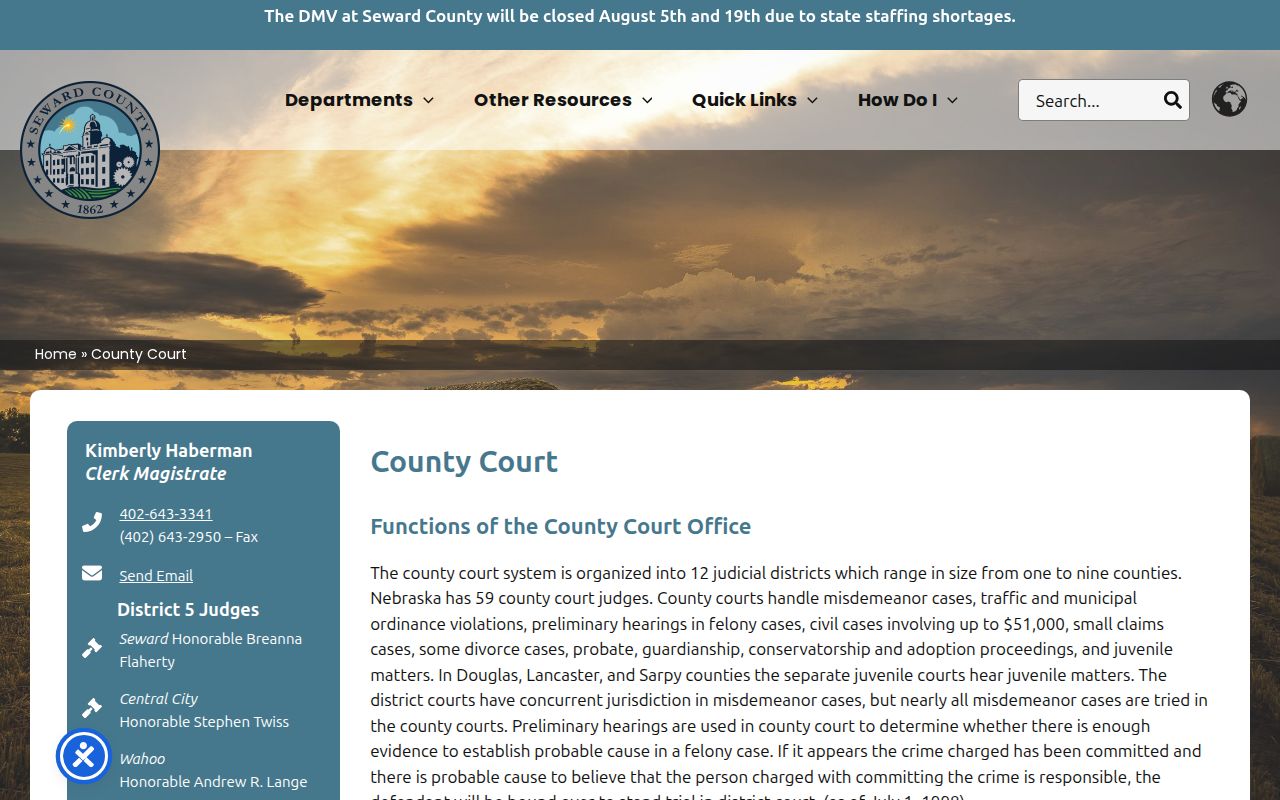
This court entry point is separate from the District Court clerk that holds the later felony file.
Seward County Felony Case Transfer
“Bind-over” is the transfer of a felony after preliminary proceedings to District Court. The first JUSTICE result may therefore be a County Court file that records the complaint, initial appearance, bond activity, and preliminary events. A later District Court file can carry the information, plea, motions, trial events, judgment, and sentence. Searching only one court can leave the Seward County criminal case looking unfinished.
The charge may also change. An arresting officer records an initial arrest charge, but the County Attorney decides what to file. A complaint can be amended, counts can be dismissed, and a plea can resolve a different count. The filed docket and final judgment control the court outcome. An arrest entry by itself does not establish guilt.
When a name yields a County Court felony entry without a final result, note its case number and dates. Then repeat the search in District Court. The register of actions may state that the matter was bound over, while the District Court file supplies the rest.
How to Search Case Records
JUSTICE, Nebraska Trial Courts Case Search, provides courthouse-terminal, one-time, and subscriber routes. The Justice Center terminal is free. The one-time statewide service listed a $17 fee in its live terms on July 31, 2026, returns no more than 30 cases, keeps results for three calendar days, and generally lags court entry by 24 hours. Search broadly first because an extra middle initial can suppress a valid match.
A case number is the cleanest route when known. Name searches can be narrowed by Seward County, case year, court type, and criminal case type. Do not add every filter at once because the clerk's spelling or missing middle initial may differ from the searcher's information.
- Open the official case-information page and choose the free terminal, one-time search, or subscriber route.
- Enter the party name in “Last, First, M, Suffix” form, but omit optional fields at first.
- Select Seward County, criminal case type, and the likely court. Check both courts for a possible felony.
- Open the summary and register of actions. Match the court, filing date, charge, and attorney data.
- Give the correct clerk a case number when requesting a paper, electronic, or certified copy.
| Field Label | Type | Required | Notes |
|---|---|---|---|
| Party Name | Text | Yes for name route | Last name alone is accepted; individual format is Last, First, M, Suffix. |
| County | Multi-select | No | Choose Seward County to narrow statewide results. |
| Case Year | Dropdown | No | Add only when the broad result exceeds the cap. |
| Court Type | Dropdown | No | County Court and District Court are separate choices. |
| Case Type / Subtype | Multi-select | No | Select criminal; available subtypes depend on the main type. |
Seward County Court Search Routes
The free Justice Center terminal is useful for a person who can visit and wants to avoid the one-time online charge. Search is available by party name or case number. Online access is more convenient at a distance, but the one-time result has a 30-case cap. Common names should be searched without needless filters, then narrowed by year or court only if the cap is reached.
The District Court clerk is in Suite 145 at 261 South 8th Street, Seward, Nebraska 68434, with telephone 402-643-4895. County Court uses mailing address PO Box 37, Seward, Nebraska 68434, and telephone 402-643-3341. District Court clerk hours are listed as weekdays from 8:00 a.m. to 5:00 p.m. County Court lists the same outer hours but closes from noon to 1:00 p.m. Call before travel for closures or building rules.
The District Court clerk page shows the felony-record counter and contact details.
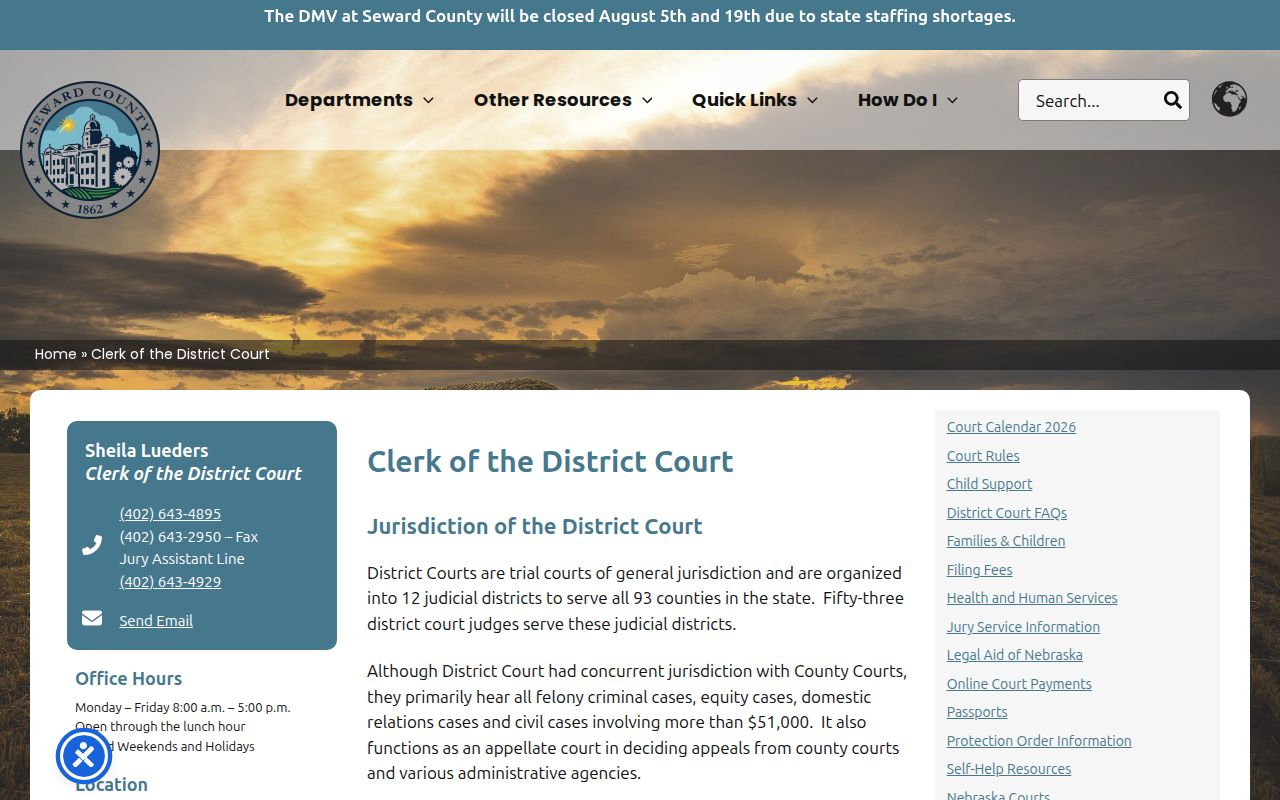
The clerk can locate a specifically identified record, but court staff do not issue a certificate saying no record exists.
What the Case File Shows
A Seward County criminal case file is organized around the court proceeding rather than the arrest cycle. The summary identifies the court, case number, case type, filing date, status, and judge. The party area lists the State, defendant, and attorneys. Offense data identifies the charge as filed. The register of actions places filings, hearings, and orders in date order.
The record can also show assessed costs, judgments, payments, and nonconfidential filed images. Sealed documents and other confidential material stay outside the public view. The most useful items for understanding an outcome are usually the charging paper, register of actions, disposition, judgment, and sentencing order.
| Case Number & Court | The unique file number, court level, case type, filing date, status, and assigned judge. |
|---|---|
| Charging Document | The complaint or information stating the prosecutor's filed allegations. |
| Docket Entries | The register of actions, including motions, notices, orders, and clerk events. |
| Hearing Dates | Past and scheduled appearances recorded on the docket. |
| Disposition & Judgment | The result of each count, such as plea, verdict, dismissal, or acquittal. |
| Sentence & Conditions | Confinement, probation, fines, restitution, and other terms shown in the judgment. |
Reading Seward County Criminal Dockets
The register of actions is the fastest way to understand movement in a case. It is a dated sequence, not a narrative report. An arraignment entry shows when charges and a plea were addressed. A motion entry shows that a party asked the court to act, but it does not prove the request was granted. Look for a later order. A disposition states how a count ended, and the judgment records the court's final action.
- Information
- A charging paper filed by the prosecutor, often in District Court after bind-over.
- Nolle prosequi
- The prosecutor's decision not to continue a charge.
- Acquittal
- A not-guilty determination, which is not the same as dismissal.
- Concurrent
- Sentences that run together rather than one after another.
Costs and payment entries are part of the JUSTICE schema, but a balance does not explain guilt or custody status. Read the judgment and sentencing entries with the financial area. Nonconfidential document images filed after April 16, 2008 are generally available through one-time results without a separate image fee, a remote-access improvement added in 2024.
Stages of a Criminal Case
The court file begins when a charging paper is filed, not when an officer first investigates. County Court handles arraignment and preliminary felony steps. Pretrial entries can include discovery notices, motions, bond review, scheduling, and diversion activity. The case then resolves by dismissal, plea, or trial. A disposition answers what happened to each count, while sentencing states the resulting court order.
Case flow: Charges Filed › Arraignment › Pretrial › Plea or Trial › Disposition › Sentencing
Some matters leave the ordinary path. The County Attorney operates five diversion programs, and the Fifth Judicial District runs a Seward/York Problem Solving Court. Successful participation can affect the final charge outcome and later public repository visibility. The docket, not the program label alone, shows what occurred in a specific Seward County criminal case.
Seward County Criminal Case Diversion
The Seward County Attorney's programs include Pretrial Diversion, Drug Accountability, Insufficient Funds, Attendance Support Program, and Parents for Change. The regional Problem Solving Court also serves Seward and York. A current 2026 application and a July 2026 graduation confirm that the specialty-court route is active. It uses treatment, supervision, assessment, testing, incentives, and sanctions for eligible nonviolent drug-related participants.
The official pretrial-diversion page describes the local program and payment channels.
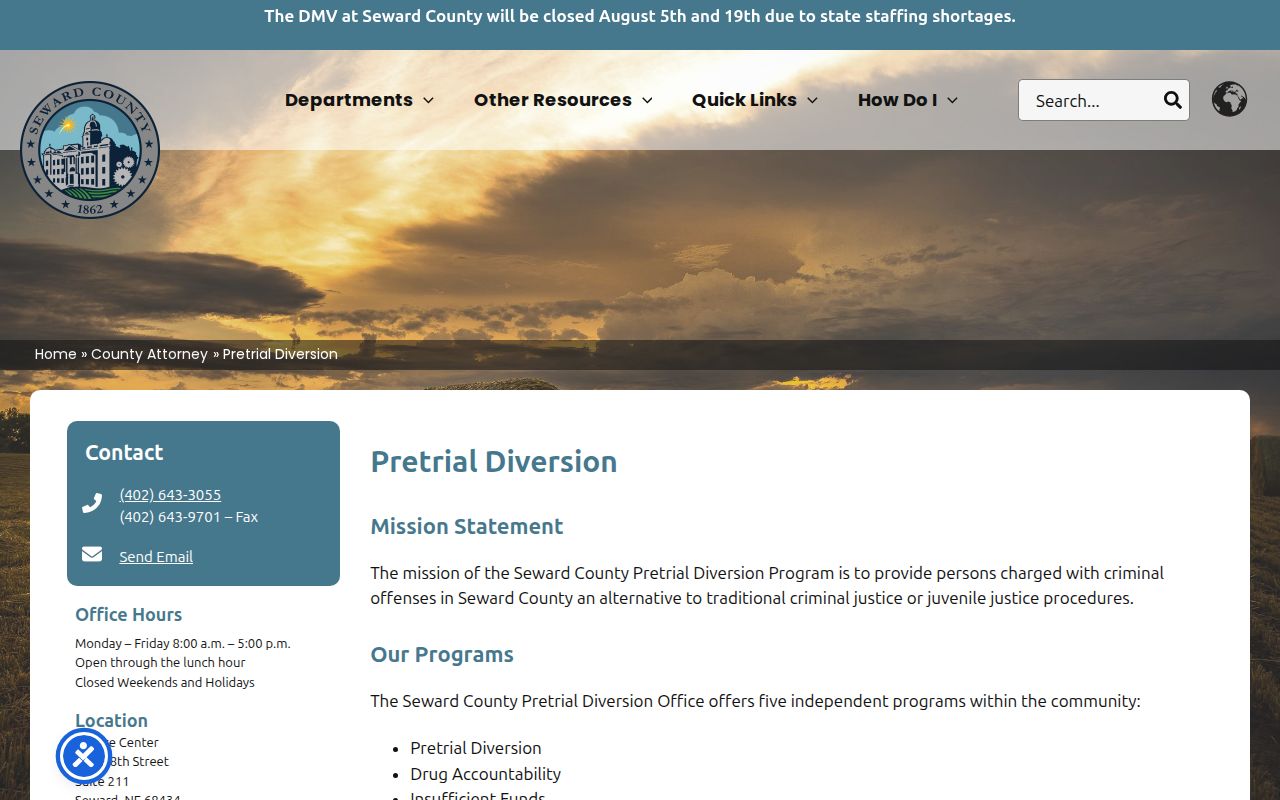
Program participation should be checked against the filed docket because enrollment alone does not state the final disposition.
A person who completes qualifying diversion may later benefit from Nebraska's public-history redaction schedule. That does not mean every case document vanishes at once. Court access rules, NSP public-view rules, and sealing law address different records. Review the result in JUSTICE and any NSP self-report separately.
Access & Restrictions
Nebraska court policy permits public-terminal searches and focused clerk copy requests while protecting sealed and confidential material. Juvenile files, victim and minor identifiers, Social Security numbers, and records covered by a sealing order may be absent or redacted. The online view may also be narrower than the clerk's public paper file. An empty result therefore calls for a case-number check with the proper clerk, not a guess that no case exists.
Older or destroyed records require a specific inquiry. Copy and certification fees follow Nebraska law, including section 33-126.05, and should be confirmed before ordering. A written request for a court document should identify the court, case number, party name, document, approximate filing date, desired format, and whether certification is needed.
The Seward County Public Defender page explains that appointed counsel is requested through County Court by a person facing possible jail who cannot afford counsel.
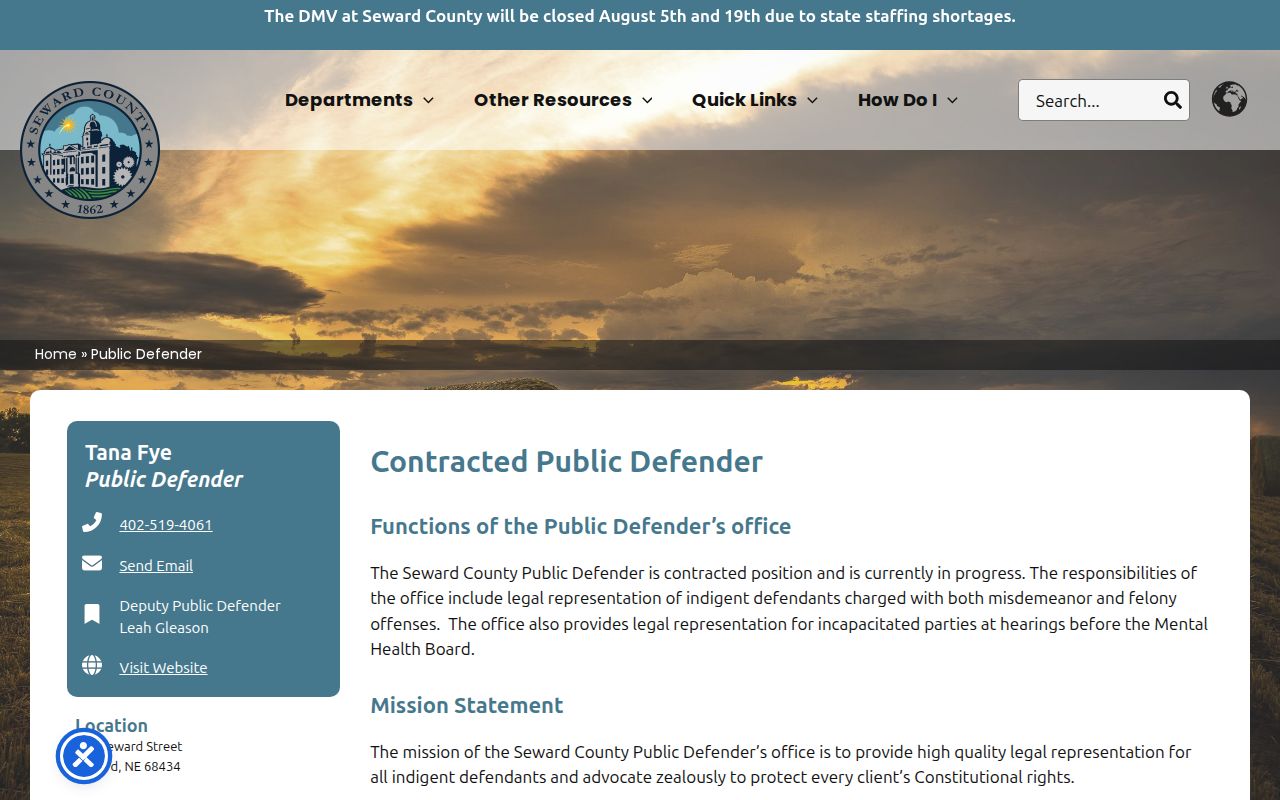
The defender is not a record custodian, but the official page helps distinguish case representation from clerk access.
When Seward County Cases Are Missing
A missing result has several possible causes. Court data may be within the normal entry lag. The name may be indexed without a middle initial or under a prior spelling. A felony may have moved from County Court to District Court. The result cap may hide a match, or the file may be sealed or confidential. Search again with fewer name fields, then use the case year and court level to narrow.
If the case still does not appear, contact the clerk with a specific name, date range, and known case number. For a new arrest, the combined jail list or Detention Center phone line may show custody before JUSTICE shows a filed case. For a final statewide fingerprint-linked record, NSP is the separate source. These checks prevent a Seward County booking entry from being mistaken for the complete court outcome.